Showing posts with label david matthews. Show all posts

Tuesday, June 16, 2015

herb-labels-for-flowerpots-etsy-2Thought these helpful tips would be nice to share! If you don't have an herb garden of your own, we, as well as most local farmer's markets everywhere have a good variety of basic herbs. 
Now that the warm weather is here we’re sending you tons of fresh seasonal herbs. As opposed to sturdier herbs, like rosemary, thyme or sage, summer herbs are more tender and need a little more TLC. Here are some tips to help maximize the freshness of these fragrant leaves!
  • Tender Herbs: Parsley, Cilantro, Dill, Tarragon, Chervil and Mint…these delicate leaves LOVE fresh water. Place them in a small jar with about 1″ of water in the bottom, cover lightly with a small plastic bag, then tie off with a rubber band. Keep in the refrigerator for up to a week.
  • Basil: This herb is a little special and needs extra attention. Not only does basil love water, it loves a little natural light and ambient or warm temperatures. Store it as you would a bouquet of flowers, and keep it out of the refrigerator!
We are Sweet Basil Farm & Gardens on Facebook. We are a local producer of farm fresh fruits and vegetables and members of the American Poultry Association, licensed by the Georgia Dept. of Agriculture as Poultry Dealers and Brokers, and a proud member of the Georgia Grown program, a division of the Georgia Dept. of Agriculture. We also breed, sell and ship poultry, pet pigs, bearded irises and much more. We have an 80 acre working farm, with great emphasis on all natural gardening and livestock management practices. An 1840s general store is situated on our property, and serves as our on-site farmer’s market. Conveniently located off of Interstate 75 near the Johnstonville Rd exit (#193).  We are six miles west, located in Barnesville, Lamar County, Georgia.
Special thanks to hellofresh.com for the fantastic blog post and to coolmompicks.com for the photo, and to J. David Matthews, of Barnesville, Ga. for contributions in testing these ideas.

Tuesday, May 12, 2015

Meet The Welsummer Breed of Chicken

imagesHISTORY
The Welsummer was developed, in the Netherlands, and was named after the village of Welsum in Holland. The breed was created with the Partridge Cochin, Partridge Wyandotte, Partridge Leghorn, later in the 20th Century, the Barnevelder and Rhode Island Red were added.  The American Poultry Association admitted the Welsummer into the American Standard of Excellence, in 1991.
QUALITIES and ATTRIBUTES 
images-1Although the American Poultry Association only recognizes one variety, with a partridge pattern, breeders are working on creating other colors. Welsummers are a medium size bird, hens should be 6 pounds, and roosters 7 pounds. The beautiful, rich brown-red hued feathers and upright single comb make the Welsummer a striking chicken. Another interesting characteristic of the Welsummers, is the male/female feather color at hatching. This makes them (what is considered to be) an autosexing breed, although not as easily discernible as a Sex Link cross.
images-2The most famous of all (make believe!) Welsummers is the Kellogg's rooster. 
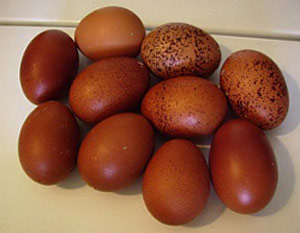
WelsummerEggsWelsummers will adapt well to any environment, although they thrive with the ability to forage, with a   very friendly demeanor. They lay approximately 200 large brown eggs a year, of a dark brown color, some even lay a speckled egg. They do not go broody, so they make a good choice for back yard egg layers. Overall, the Welsummer makes an excellent choice for a backyard chicken, or a small egg farming operation. 
If you enjoyed this article, want to know more about this or other related interesting topics, please like and share this article. Be sure to like us, so you don’t miss anything, we are Sweet Basil Farm & Gardens, on Facebook, Google+, Twitter and other social media. We are a local producer of farm fresh fruits and vegetables and members of the American Poultry Association, licensed by the Georgia Dept. of Agriculture as Poultry Dealers and Brokers, and a proud member of the Georgia Grown program, a division of the Georgia Dept. of Agriculture. We also breed, sell and ship poultry, pet pigs, bearded irises and much more. We have an 80 acre working farm, putting great emphasis on all natural gardening and livestock management practices. An 1840s general store is situated on our property, and serves as our on-site farmer’s market. Fresh garden vegetables, fruit nuts, eggs and flowers straight from the garden to you. We pick during the week, YOU pick available on Friday and Saturday. Conveniently located off of Interstate 75 near the Johnstonville Rd exit (#193).  We are six miles west, located in Barnesville, Lamar County, Georgia.
Special thanks to the American Standard of Perfection by the American Poultry Association, The Chicken Encyclopedia by Gail Damerow, Storey’s Illustrated Guide to Poultry Breeds by Carol Ekarius, Hobby Farms Guide to Chicken Breeds, Poultry World, the magazine for helpful information, as well as contributions from J. David Matthews, of Barnesville, Georgia in preparation of this article. Photo credits to imgkid.com, Pinterest, and Kellogg's. 

Monday, May 11, 2015

Easy Spicy Honey-Glazed Chicken Breasts Recipe from Sweet Basil


This sweet and spicy chicken recipe tastes like a gourmet recipe, but can be done in the same amount of time of preparing Hamburger Helper. You can use farm fresh products for most of the ingredient list. 


ingredients


  • 1/4 cup extra-virgin olive oil
  • 1 small onion, finely chopped
  • 1 clove garlic, finely chopped
  • 1/2 cup honey
  • 2 teaspoons hot pepper sauce
  • 1/2 teaspoon chili powder
  • 1 teaspoon lemon juice
  • 8 skinless, boneless chicken breasts (about 4 pounds)
  • Salt
  • 1 pineapple peeled, cored and cut into 8 thick rings


directions
  1. In a small saucepan, heat 1 tablespoon olive oil over medium heat. Add the onion and garlic and cook, stirring, until translucent and beginning to brown, 6 to 8 minutes. Add the honey, hot pepper sauce and chili powder and simmer for 1 minute. Remove from the heat, stir in the lemon juice and set aside.
  2. Preheat a grill or large grill pan to medium-high. Rub the chicken with the remaining 3 tablespoons olive oil and season with salt. Grill until well marked, about 7 minutes. Flip and cook until the bottoms are well marked and the chicken is cooked through, another 2 minutes. Transfer to a plate and brush with the reserved honey glaze. Cover with foil and let rest for 5 minutes.
  3. Meanwhile, grill the pineapple until well marked on one side, about 4 minutes, then flip and cook for another 2 minutes. Serve with the chicken.

Enjoy! 

We are Sweet Basil Farm & Gardens on Facebook. We are a local producer of farm fresh fruits and vegetables and members of the American Poultry Association, licensed by the Georgia Dept. of Agriculture as Poultry Dealers and Brokers, and a proud member of the Georgia Grown program, a division of the Georgia Dept. of Agriculture. We also breed, sell and ship poultry, pet pigs, bearded irises and much more. We have an 80 acre working farm, with great emphasis on all natural gardening and livestock management practices. An 1840s general store is situated on our property, and serves as our on-site farmer’s market. Conveniently located off of Interstate 75 near the Johnstonville Rd exit (#193).  We are six miles west, located in Barnesville, Lamar County, Georgia.
Special thanks to Rachel Ray for the fabulous recipe, as well as contributions from J. David Matthews, of Barnesville, Georgia in preparation of testing this recipe.

Sunday, May 3, 2015

MEET THE RHODE ISLAND RED CHICKEN

Rhode_Island_Red_cock,_croppedHISTORY
The Rhode Island Red chicken was deliberately created for high egg production, high-quality meat production and resistance to some diseases, with development beginning around the mid-1800’s. It was named the Rhode Island Red, after the state of it’s origination. The American Poultry Association admitted the single comb variety in 1904, and the rose comb variety in 1905. During the 1940’s, when commercial egg production exploded, the production variety was created. In 1954, the Rhode Island Red became the State bird of Rhode Island, making it the only breed the American Poultry Association recognizes to have such an honor.
QUALITIES and ATTRIBUTES 
Many experts consider the Rhode Island Red to be the most popular variety of chicken in the United States, and possibly the world. The feathers on the body, hackle (collective group of feathers along neck) and saddle (cock’s long pointed feathers on the rear of the back)  are a lustrous dark, rich red color, with the undercolor (fluff underneath the feathers) a rich intense red. The wings are black, outlined with red and tail feathers are a lustrous greenish black, giving this bird its striking appearance.
The single comb variety should be moderately large and have five, well defined points. The Rose comb should be moderately large and close on head, oval shaped and the surface covered with small, rounded points. Both varieties have red combs and medium sized wattles (two flaps that dangle under the beak). Mature cocks should weigh about 8 1/2 pounds, and hens about 6 1/2, making them a nice table bird. Hens lay more than 200 large brown eggs, annually, and hens (heritage breeds) that brood make nice mothers. Due to their calm, docile personalities, they do well in confinement as well as a backyard chicken. Fencing for containment need not be high, the Rhode Island Red does not display strong flying skills. However, they also do well in a free range environment. Rhode Island Reds tolerate heat well, making them an excellent breed for warmer areas.
To learn more about this breed, or other breeds, like or comment below. If you enjoyed this article, want to know more about this or other related interesting topics, please like and share this article. Be sure to like us, so you don’t miss anything, we are Sweet Basil Farm & Gardens on Facebook. We breed sell and ship poultry, pet pigs, bearded irises and much more. We have an 80 acre working farm, with great emphasis on all natural gardening and livestock management practices. We are blessed to have an 1840s General Store on our property which serves as our own site farmer’s market. Conveniently located on Johnstonville Rd., in Barnesville, Georgia, right off of I-75.
Special thanks to the American Standard of Perfection by the American Poultry Association, The Chicken Encyclopedia by Gail Damerow, Storey's Illustrated Guide to Poultry Breeds by Carol Ekarius,  for helpful information and contributions from David Matthews, of Barnesville, Georgia in preparation of this article. Photo credits to Wikipedia.

Natural And Alternative Tips For Garden Pest Control

11174923_1037494746278600_7404043103471160029_n-2Spring rains bring new health and life to our gardens. Unfortunately, they also create the perfect haven for pests to thrive. There are many safe, non-toxic alternatives to ridding and deterring unwanted guests from your gardens. These natural solutions have been tried and tested by Sweet Basil Farm & Gardens, and many before us. You may find it helpful to try a combination or variation of these, to best suit your particular situation.
Identify Your Insects
Identify all of the insects in your garden. Keeping good bugs like assassin bugs, praying mantis, lady-beetles (ladybugs) beetles, and spiders in your yard will be a huge help. They eat bad bugs! There are several ways to attract beneficial insects, and you can even order lady bugs online.
Natural Pesticide Sprays
Aphids and other similar insects can be sprayed with a dish soap and water solution, neem oil, and even peppermint essential oil. The soap solution should be sprayed directly where aphids or other harmful insects are present. The oils can be misted over the entire plant, and both have amazing health benefits to humans, as well. (That’s for another day!)
Create A Pest Barrier
Make a barrier with sawdust, ashes, or wood chips around your garden to deter certain pests, such as slugs and snails. Keep in mind that all of these will change the pH in your soil, so if barriers are close to planting areas, make sure to test your soil pH! (Most Agriculture Extension Agents will test it for you for a nominal fee.)
If you only want to protect certain plants, you can create a barrier around those specific plants. You can use plastic or metal scraps, such as tin or aluminum fool, just be sure to bury it several inches into the ground around the base of the plant. This works well for cutworms or other crawling or burrowing insects.
Use of Garlic and Herbs for Natural Pest Control
Planting garlic or herbs in your garden will deter many unwanted insects and other pests. Plant the garlic or herbs throughout your garden to keep pests at bay. To help keep deer away, plant herbs upwind from where the deer enter the area around your garden. Deer do not like strong scents! You can’t go wrong with these, your kitchen will smell amazing and your recipes delicious.
Use of Native Flowers & Shrubs are a Natural Alternative
Plant native shrubs, perennials and annuals. Most native varieties have evolved and survived hundreds of years in your area, facing the same issues you are facing. You can make a unique and beautiful native garden, that will be hardy and well suited to your ecosystem. For the best varieties, make sure to visit Lady Bird Johnson’s site, wildflowers.com.
Use of Poultry in Your Pest Control Plan
Keep ducks, guineas, geese and chickens in your yard. They love insects, and weeds! They are also very entertaining to watch, and can help you be more self sustaining with eggs and/or meat. Make sure to give them water and a safe shelter for nighttime and inclement weather.
Nature's Best Exterminators
Bats...Having bats in the yard is not such a bad thing, and in fact most people do not even notice if they are around. They only come out at night, and eat pesky nocturnal insects. An average bat eats 3500 insects a night! Mosquitoes are active when bats are coming out for the night, so a colony of bats could do better than any can of spray ever could! (Ready to build a bat house yet???)
Frogs & Toads...Not only are they a joy to watch, but they will eat a lot of bugs in your garden. To help them be the most effective where you need them, provide light close to where the problem is (such as solar lights) to attract the bugs. You can easily make a haven, or even a mini mansion for frogs by simply adding a small light, a few rocks and a water source.
Try Using Chili Powder In Your Garden
For larger pests, use chili powder around your garden. Chili powder which will deter things like deer, raccoons, skunks, and opossums. It doesn’t harm the critters any more than it does us, just makes them sneezy and maybe a little thirsty. Don’t forget to save and dry hot peppers from your own garden this year, to make your own chili powder.
Lights And Noise For Pest Distraction
Lights, fans, radios, sprinklers and flags will deter wildlife. The movement and noise from these things will frighten unwanted wildlife from your garden. Scarecrows have been used for centuries. Timers and motion sensors are helpful, because the element of surprise is maintained.
There are many natural and alternative ways to rid your garden of pests. Though you may have to try a few, maybe even a combination, in the long run you will be helping your family, food and environment be much safer for all. If you have tried and succeeded with other ideas, please feel free to share them with us all. After all, when we make natural or alternative choices for ourselves, we are also helping our neighbors, a little bit at a time.
If you enjoyed this article, want to know more about this or other related interesting topics, please like and share this article. Be sure to like us, so you don’t miss anything, we are Sweet Basil Farm & Gardens on Facebook. We breed sell and ship poultry, pet pigs, bearded irises and much more. We have an 80 acre working farm, with great emphasis on all natural gardening and livestock management practices. We are blessed to have an 1840s General Store on our property which serves as our own site farmer’s market. Conveniently located on Johnstonville Rd., in Barnesville, Georgia, right off of I-75.
Special thanks to mymerrymessylife.com for helpful information and contributions by David Matthews in preparation of this article. Photo credits to Wikipedia.

MEET THE POLISH BREED OF CHICKEN

polish_chickenHISTORY
There is little known about the origination of the Polish, except that it is one of the oldest breeds of chicken. However, it is known that the Polish chicken was depicted in paintings of the fifteenth century, and mentioned as a pure breed in writings in Europe as early as the sixteenth century. Archaeological evidence has also been found proving that crested breeds existed as far back as Roman times.
Perfection, if not origination, of the breed is believed to have been in Holland, but there are strong indications that both Spain and Italy were involved as well in development of the breed, as we know it today. The first Polish arrived in the United States in the mid seventeenth century, from England. The American Poultry Association first admitted the Polish in 1874, in the Continental Class. The APA’s Standard of Perfection consists of four varieties being admitted in 1874, four more in 1883, one variety in 1938, 1963 and 1996. The name “Polish” is more than likely due to the poll, the bony structure on the head, giving rise to the crest, a puff of feathers on the head. Charles Darwin classified all races of fowl with topknots as “Crested or Polish”, although he gave no data as to the origination of the breed we know as the Polish.
QUALITIES and ATTRIBUTES 
Polish chickens come in a variety of colors, and both bearded and non bearded. The American Poultry Association recognizes the Black Crested White, White Crested Black, White Crested Blue, Silver, Golden, White and Buff Laced varieties. Other colors and patterns not recognized, but being worked on by organizations such as the Polish Breeders Club, include laced and spangled, chocolate, mottled, splash, crele, cuckoo, red and more.
The Polish legs and feet are smooth and a slate or blue color. Some varieties have beards and muffs, with small wattles. The non bearded varieties have larger wattles. The v-shaped comb should be small, and set evenly on head, retreating into the crest. According to the APA’s Standard of Perfection, the smaller the comb, the better, and in fact the natural absence of crest is preferred. The nostrils are large, wide and cavernous that is found only in crested breeds. The male’s crest should be very large and free from any split or part, and the females should be small, compact and globular shaped. The crests, also known as topknots make male and females easily distinguishable, even from a distance.
This breed is available in both standard and bantam sizes. Mature standard sized roosters  should weigh 6 pounds, and hens 4 1/2 pounds. Bantam roosters should weigh 30 ounces and hens 26 ounces. The Polish are considered an ornamental breed, kept mainly by fanciers, but since they lay about 200 medium-to-large white eggs, per year, they make a fine backyard chicken. These chickens are very friendly and calm, making them excellent pets, especially for children. They are very entertaining to watch, always strutting their beautiful crests and flowing tail feathers. Due to their impressive crests, their vision can be restricted, so an enclosed coop/run and only allowing them out with close supervision is a must for their protection. Although they can be a bit flighty, they do tolerate confinement well.
If you enjoyed this article, want to know more about this or other related interesting topics, please like and share this article. Be sure to like us, so you don’t miss anything, we are Sweet Basil Farm & Gardens on Facebook. We breed sell and ship poultry, pet pigs, bearded irises and much more. We have an 80 acre working farm, with great emphasis on all natural gardening and livestock management practices. We are blessed to have an 1840s General Store on our property which serves as our own site farmer’s market. Conveniently located on Johnstonville Rd., in Barnesville, Georgia, right off of I-75.
Special thanks to the American Standard of Perfection by the American Poultry Association, The Chicken Encyclopedia by Gail Damerow, Storey’s Illustrated Guide to Poultry Breeds by Carol Ekarius,  for helpful information and contributions from David Matthews, of Barnesville, Georgia in preparation of this article. Photo credits to Wikipedia.

Our Daily Bread at Sweet Basil Farm & Gardens

IMG_8511
"I thank you God for this most amazing day, for the leaping greenly spirits of trees, and for the blue dream of sky and for everything which is natural, which is infinite."  E.E. Cummings
We are Sweet Basil Farm & Gardens on Facebook. We are a local producer of farm fresh fruits and vegetables and members of the American Poultry Association, licensed by the Georgia Dept. of Agriculture as Poultry Dealers and Brokers, and a proud member of the Georgia Grown program, a division of the Georgia Dept. of Agriculture. We also breed, sell and ship poultry, pet pigs, bearded irises and much more. We have an 80 acre working farm, with great emphasis on all natural gardening and livestock management practices. An 1840s general store is situated on our property, and serves as our on-site farmer's market. Conveniently located off of Interstate 75 near the Johnstonville Rd exit (#193).  We are six miles west, located in Barnesville, Lamar County, Georgia.
Written by John "David" Matthews, with contribution from his partner, Tisha, of Barnesville, Georgia. Photo credits to wallpaperbase.org.

Mini Chicken Pot Pies

mini-chicken-pot-pies-hl-1949721-xEasy Family Recipe from Sweet Basil Farm & Garden

Ingredients

  • 1 sheet frozen puff pastry dough, thawed
  • 2 teaspoons unsalted butter
  • 2 teaspoons olive oil
  • 3 tablespoons all-purpose flour
  • 2 cups 2% reduced-fat milk
  • 2 tablespoons lemon juice
  • 2 cups shredded leftover or rotisserie chicken
  • 2 cups roasted or steamed vegetables, (carrots, peas, beans, potatoes, corn) coarsely chopped
  • 1/4 cup coarsely chopped fresh basil
  • 1/2 teaspoon salt
  • 1/4 teaspoon pepper
  • 4 fresh sage leaves (shredded)
  • 1 large egg white, beaten

Directions

Preheat oven to 325 degrees. Roll out puff pastry to 1/4-inch thick, and cut into 4 (6-inch) rounds to fit over 1-cup ovenproof bowls. Keep pastry covered and chilled. (If pressed for time, individual frozen pie crusts may be used, and topped with frozen biscuits or Bisquick mix.)
Heat butter and oil in a medium saucepan over moderate heat; add flour, and cook, whisking constantly, for 1 minute. Add the milk in a slow stream while whisking constantly; bring the mixture to a simmer. Simmer for about 5 minutes or until thickened. Stir in next 6 ingredients (through pepper). Spoon mixture into ovenproof bowls. Top bowls with pastry, pressing against the outside edge of the bowls to seal. Place a sage leaf on top of pastry, and brush with egg white.
Bake pot pies on a baking sheet in middle of oven for 17 minutes or until pastry is golden brown. Serve hot.
We are Sweet Basil Farm & Gardens on Facebook. We are a local producer of farm fresh fruits and vegetables and members of the American Poultry Association, licensed by the Georgia Dept. of Agriculture as Poultry Dealers and Brokers, and a proud member of the Georgia Grown program, a division of the Georgia Dept. of Agriculture. We also breed, sell and ship poultry, pet pigs, bearded irises and much more. We have an 80 acre working farm, with great emphasis on all natural gardening and livestock management practices. An 1840s general store is situated on our property, and serves as our on-site farmer’s market. Conveniently located off of Interstate 75 near the Johnstonville Rd exit (#193).  We are six miles west, located in Barnesville, Lamar County, Georgia.
Recipe inspiration and photo credit thanks to Health.com, and contribution from J. David Matthews, Barnesville, Georgia.

MEET THE ORPINGTON BREED OF CHICKEN

2086739872_d954d2f626HISTORY
William Cook, a successful poultryman in England, developed the black Orpington in the 1880s. Mr. Cook introduced the breed in 1886 at a poultry show, and won the grand prize cup. The American Poultry Association first admitted the Buff Orpington in 1902, the Black Orpington and White Orpington in 1905, and later the Blue Orpington in 1923. The first Orpington, a Black, first came to America in 1890, and was exhibited in 1895. The original Orpington was created using a cross of Black Minorca, Black Plymouth Rock, and Black Langshan. Other crosses were used to create the Buff and White varieties, and the Black and White were crossed to create the Blue.
QUALITIES and ATTRIBUTES 
Orpington chickens come in a variety of colors, the most common being Buff. The other varieties, not recognized by the American Poultry Association are Jubilee, Spangled (Mottled), Chocolate, Lavender, Splash, Gold Laced, Silver Laced, Lemon, Cuckoo, Partridge, Red and more.
The Orpingtons’ leg colors will vary depending on the variety, however, the Black should have black legs while young, fading to a slate color in adults and the Buff should be a pinkish white. The single comb should be medium in size, and set firmly on head, perfectly straight and upright, with five well-defined points.
This breed is available in both standard and bantam sizes. Mature standard sized roosters should weigh 10 pounds, and hens 8 pounds. Bantam roosters should weigh 38 ounces and hens 34 ounces. The Orpington is a dual purpose breed, being a large breed and laying around 200 large brown eggs, per year. The Orpington chicken is like the Labrador Retriever of dogs, very friendly, docile and affectionate and make excellent pets. Orpingtons tolerate confinement, as well as easily free range. Their heavy size makes them safer from aerial predators. Their feathers are quite broad and full, giving them a substantial stature, and also tolerate cold temperatures well. Hens often go broody and make excellent mothers.
If you enjoyed this article, want to know more about this or other related interesting topics, please like and share this article. Be sure to like us, so you don’t miss anything, we are Sweet Basil Farm & Gardens, on Facebook and other social media. We are a local producer of farm fresh fruits and vegetables and members of the American Poultry Association, licensed by the Georgia Dept. of Agriculture as Poultry Dealers and Brokers, and a proud member of the Georgia Grown program, a division of the Georgia Dept. of Agriculture. We also breed, sell and ship poultry, pet pigs, bearded irises and much more. We have an 80 acre working farm, putting great emphasis on all natural gardening and livestock management practices. An 1840s general store is situated on our property, and serves as our on-site farmer’s market. Conveniently located off of Interstate 75 near the Johnstonville Rd exit (#193).  We are six miles west, located in Barnesville, Lamar County, Georgia.
Special thanks to the American Standard of Perfection by the American Poultry Association, The Chicken Encyclopedia by Gail Damerow, Storey’s Illustrated Guide to Poultry Breeds by Carol Ekarius,  Hobby Farms Guide to Chicken Breeds, for helpful information, as well as contributions from J. David Matthews, of Barnesville, Georgia in preparation of this article. Photo credits to Wikipedia.

Now Blooming...Bearded Irises

With their swordlike leaves and showy flowers, bearded iris are an eye-catching addition to any garden. They're easy to plant, require minimum care, and readily multiply. Even if you grow nothing but bearded irises, you can enjoy a remarkable range of color and a bloom season extending for months. These perennials flourish in USDA Zones 3-9.
Bearded irises are identified by thick, bushy "beards" on each of the falls (lower petals) of the blossoms. The flowers are constructed with three upright "standard" petals and three drooping "fall" petals, which are often different colors. The falls may be "bearded" or not. 
Originally, most bearded irises were native to central and southern Europe. Some bearded irises are "rebloomers", blooming again in the summer, fall or winter. Additional water and fertilizer applied during the late spring and summer months encourages them to bloom again. There are rebloomers available which will perform in all but the coldest climates. Spring planting is discouraged but can be done under abnormal circumstances, however it often results in lack of bloom for a season or two and slow establishment.
Bearded iris need a balanced, well-drained soil but are very adaptable to a variety of soil types. Raised beds can help with drainage and are a MUST for areas with high rainfall. Iris, like most perennials, prefer neutral to slightly acidic soil (pH of 6.8 - 7.0 is ideal). Heavy clays need to be amended with gypsum or coarse sand to aid drainage. Iris can be mulched lightly (for winter protection and weed control) as long as the mulch does not cover the rhizome. Once winter is over, it is wise to remove the mulch.
PLANTING
Plant bearded iris in mid summer to early fall, spacing plants 1 to 2 feet apart, depending on variety. Excellent soil drainage is a must. Prepare garden bed by using a garden fork or tiller to loosen soil to a depth of 12 to 15 inches, then mix in a 2- to 4-inch layer of compost or bone meal. If planting a rhizome (fleshy root), dig a shallow hole 10 inches in diameter and 4 inches deep. Make a ridge of soil down the middle and place the rhizome on the ridge, spreading roots out to support the plant, replace the soil, firmly pack around the roots to remove air pockets and water liberally. In clay soil, the top of the rhizome should be exposed. In sandy soil, rhizomes can be buried with a thin layer of soil. If planting container-grown plants, set the plant so the rhizome is at the soil surface. Water thoroughly.
DO NOT plant bearded iris in a low area; they will not tolerate standing water. 14-18” is a good distance between rhizomes. For mass or clump style plantings, plant rhizomes in a triangular fashion about 6” apart.  In areas of intense summer heat or light soils, irises can be planted deeper (no more than 1” below the soils surface) to avoid scalding.
CARE
Apply a thin layer of compost around the base of plants each spring, leaving the rhizome (fleshy root) exposed. As flowers fade, cut back the flower stalks to the base of the plant, making sure to leave the fan leaves. To encourage a second bloom on reblooming varieties, promptly remove faded flowers and maintain consistent watering throughout the summer. In autumn, trim away dead foliage and prune back healthy leaves to a height of 4 to 5 inches. Once the soil has frozen, apply a layer of mulch to help prevent roots from heaving out of the soil during alternate freezing and thawing. If heaving occurs, don't try to force plants back into the soil. Instead, cover rhizomes and exposed roots with soil. Divide bearded iris every 4 to 5 years, preferably in late summer. Each division should have one or two leaf fans. Older rhizomes that have few white feeding roots should be discarded.
Specific fertilizer recommendations depend on your soil type, but bone meal, superphosphate and 6-10-10 are all effective. A light application in the early spring and a second light application about a month after bloom will reward you with good growth and bloom. Avoid using anything high in nitrogen, as nitrogen encourages rot problems.
We have and sell over 300 varieties of Bearded Irises growing in our gardens, with more being added this Fall.
If you enjoyed this article, want to know more about this or other related interesting topics, please like and share this article. Be sure to like us, so you don’t miss anything, we are Sweet Basil Farm & Gardens, on Facebook and other social media. We are a local producer of farm fresh fruits and vegetables and members of the American Poultry Association, licensed by the Georgia Dept. of Agriculture as Poultry Dealers and Brokers, and a proud member of the Georgia Grown program, a division of the Georgia Dept. of Agriculture. We also breed, sell and ship poultry, pet pigs, bearded irises and much more. We have an 80 acre working farm, putting great emphasis on all natural gardening and livestock management practices. An 1840s general store is situated on our property, and serves as our on-site farmer’s market. Conveniently located off of Interstate 75 near the Johnstonville Rd exit (#193).  We are six miles west, located in Barnesville, Lamar County, Georgia.
Special thanks to the American Iris Society and Better Homes and Gardensfor helpful information, as well as contributions from J. David Matthews, of Barnesville, Georgia in preparation of this article. Photo credits to Sweet Basil Farm & Gardens. DSC_0064

Herb Crusted Roasted Chicken

Herb_Crusted_Roast_Chicken-580HERB CRUSTED ROASTED CHICKEN
INGREDIENTS
* 3-4lb Whole Chicken
* Something to stuff inside the chicken (Apple, Onion, Lemon, Garlic, etc.)
* Pecan or Canola Oil
* Salt and Pepper
* Fresh Herbs (I use a generous amount of Rosemary, Thyme, Basil, Bay leaves, Sage)
DIRECTIONS
You can stuff various items into a fresh chicken for roasting and this will provide additional moisture and aromatics that will help to flavor the chicken from the inside. I’m using a lemon and some garlic cloves. For the outside, I use  a combination of fresh Sage, Rosemary, and Thyme.
Preheat your oven to 450 degrees while you pick the herbs from their stems.
Chop herbs.
Toss those herbs into a bowl and add in your salt and pepper.
For EACH chicken you’ll be roasting, you’ll need:
* 1-2 Tablespoons of chopped herbs
* 1 Tablespoon of salt (kosher is best)
* 1 Teaspoon of pepper
Add to that 2-3 tablespoons of pecan oil, and stir.
Before applying herb mixture to the outside of the chicken, fill the cavity of the bird with aromatics. Aromatics won't be eaten, so just give them a rough chop / slice / mash. Pat chicken dry with a clean cloth or paper towel, helping to insure a nice crust after roasting. Rub entire chicken with canola herb mixture.
Roast herb coated chicken(s) into a 450 degree oven for an hour to an hour and fifteen minutes until they are golden brown and have developed a delicious crust.
ENJOY!!!
If you enjoyed this recipe, want to know more about this or other related interesting topics, please like and share this article. Be sure to like us, so you don’t miss anything, we are Sweet Basil Farm & Gardens, on Facebook and other social media. We are a local producer of farm fresh fruits and vegetables and members of the American Poultry Association, licensed by the Georgia Dept. of Agriculture as Poultry Dealers and Brokers, and a proud member of the Georgia Grown program, a division of the Georgia Dept. of Agriculture. We also breed, sell and ship poultry, pet pigs, bearded irises and much more. We have an 80 acre working farm, putting great emphasis on all natural gardening and livestock management practices. An 1840s general store is situated on our property, and serves as our on-site farmer’s market. Conveniently located off of Interstate 75 near the Johnstonville Rd exit (#193).  We are six miles west, located in Barnesville, Lamar County, Georgia.
Special thanks to the Cooking On The Side for helpful information, as well as contributions from J. David Matthews, of Barnesville, Georgia in preparation of this article.

Pizza Casserole Deluxe


Kid approved, easy family dinner! Use garden fresh bell peppers and garlic!
Ingredients
1 (1-lb.) package ground mild Italian sausage 
2 garlic cloves, minced
1 tablespoon olive oil
1 (26-oz.) jar marinara sauce
1 teaspoon kosher salt, divided
1/2 medium-size red onion, chopped
1/2 medium-size red bell pepper, chopped
1/2 medium-size green bell pepper, chopped
1/2 (8-oz.) package sliced mushrooms
1 cup sliced black olives
1/2 cup pepperoni slices, chopped
1 (16-oz.) package rigatoni pasta
3 tablespoons butter or margarine
3 tablespoons all-purpose flour
3 cups half-and-half
8 ounces fresh mozzarella, shredded (2 cups)
1/2 cup grated Parmesan cheese
1/2 teaspoon freshly ground black pepper
1 (8-oz.) package shredded mozzarella cheese
1 package of pepperoni slices, Canadian bacon, and/or 1/2-1 lb. browned and crumbled sausage or hamburger
Directions
Preheat oven to 350°. Cook sausage and garlic in hot oil in a large skillet over medium-high heat 5 to 7 minutes or until sausage crumbles and is no longer pink. Remove with a slotted spoon, reserving drippings in skillet. Drain sausage mixture on paper towels, and transfer to a medium bowl. Stir marinara sauce and 1/2 tsp. salt into sausage mixture.
Sauté onion and next 3 ingredients in hot drippings 5 minutes or until tender; stir in olives and chopped pepperoni. Reserve 1/4 cup onion mixture.
Prepare pasta according to package directions in a large Dutch oven.
Melt butter in a heavy saucepan over low heat; whisk in flour until smooth. Cook, whisking constantly, 1 minute. Gradually whisk in half-and-half; cook over medium heat, whisking constantly, 7 to 10 minutes or until mixture is thickened and bubbly. Stir in fresh mozzarella cheese, Parmesan cheese, pepper, and remaining 1/2 tsp. salt. Pour sauce over pasta in Dutch oven, stirring to coat. Stir in onion mixture.
Transfer pasta mixture to a lightly greased 13- x 9-inch baking dish, and top with sausage mixture, packaged mozzarella cheese, reserved 1/4 cup onion mixture, and pepperoni slices.
Bake at 350° for 30 minutes or until cheese is melted and lightly browned. Let stand 5 minutes before serving.
Enjoy!
If you enjoyed this recipe, want to know more about this or other related interesting topics, please like and share this article. Be sure to like us, so you don’t miss anything, we are Sweet Basil Farm & Gardens, on Facebook and other social media. We are a local producer of farm fresh fruits and vegetables and members of the American Poultry Association, licensed by the Georgia Dept. of Agriculture as Poultry Dealers and Brokers, and a proud member of the Georgia Grown program, a division of the Georgia Dept. of Agriculture. We also breed, sell and ship poultry, pet pigs, bearded irises and much more. We have an 80 acre working farm, putting great emphasis on all natural gardening and livestock management practices. An 1840s general store is situated on our property, and serves as our on-site farmer’s market. Conveniently located off of Interstate 75 near the Johnstonville Rd exit (#193).  We are six miles west, located in Barnesville, Lamar County, Georgia.
Special thanks to food .com for helpful information, as well as contributions from J. David Matthews, of Barnesville, Georgia in preparation of this article.

Tips For Controlling Weed Growth

After all of the April showers, we will surely have May flowers...and weeds! Take preventative measures now, before they set their roots in to your flower bed. Sweet Basil has collected ideas below and has tried and tested. These ideas not only work, but are much easier (& safer!) than chemicals, blow torches, and even pulling!


LET SLEEPING WEEDS LIE

Kill weeds at their roots but leave the soil—and dormant weed seeds—largely undisturbed.
 
Every square inch of your garden contains weed seeds, but only those in the top inch or two of soil get enough light to trigger germination. Digging and cultivating brings hidden weed seeds to the surface, so assume weed seeds are there ready to erupt, like ants from an upset anthill, every time you open a patch of ground. Dig only when you need to and immediately salve the disturbed spot with plants or mulch. In lawns, minimize soil disturbance by using a sharp knife with a narrow blade to slice through the roots of dandelions and other lawn weeds to sever their feed source rather than digging them out. Keep in mind that weed seeds can remain dormant for a long, long time.
 
Some folks say it helps to turn your soil at night to control weeds. Research indicates that weeds may be stimulated to grow by a sudden flash of light, which is what you give them when you turn the soil over during the day. A German study concluded that by turning the soil at night, weed germination could be reduced by as much as 78 percent. You can try this method by working during a moonlit night, or at dawn or dusk.

MULCH, MULCH, MULCH

Don’t give weeds the chance to see the light. Whether you choose wood chips, bark nuggets, straw, or even pine needles, keep the mulch coming to smother out weeds.
 
Mulch benefits plants by keeping the soil cool and moist and depriving weeds of light. Organic mulches, in particular, can actually host crickets and carabid beetles, which seek out and devour thousands of weed seeds.
Some light passes through chunky mulches, and often you will discover—too late—that the mulch you used was laced with weed seeds. It’s important to replenish the mulch as needed to keep it about 2 inches deep (more than 3 inches deep can deprive soil of oxygen). In any case, you can set weeds way back by covering the soil’s surface with a light-blocking sheet of cardboard, newspaper, or biode­gradable fabric and then spreading prettier mulch over it.
If you choose to use this method on seldom-dug areas, such as the root zones of shrubs and trees, opt for tough landscape fabric for the light-blocking bottom sheet. There is a catch, however: As soon as enough organic matter accumulates on the landscape fabric, weed seeds dropped by birds or carried in on the wind will start to grow. For the bottom layer of fabric to be effective, these must be pulled before they sink their roots through and into the ground.
My favorite way to mulch is to lay newspaper down, wet it, then put down a thick layer of pine straw. I have found that nutsedge and a few other dreadful weeds do not grow as well with pine products. After mulching, using Preen or another pre-emergent is a good idea. It will save a lot of time and energy later. There is even an organic version.

WEED WHEN THE WEEDING’S GOOD

Young weeds go down much easier than older ones, so make the most of good weeding conditions.
 
The old saying “Pull when wet; hoe when dry” is wise advice when facing down weeds. After a drenching rain, stage a rewarding weeding session by equipping yourself with gloves, a sitting pad, and a tarp for collecting the corpses. As you head out the door, slip an old table fork into your back pocket because there’s nothing better for twisting out tendrils of henbit or chickweed. When going after bigger thugs, use a fishtail weeder or a flathead screwdriver to pry up taprooted weeds, like dandelion or dock.
Under dry conditions, weeds sliced off just below the soil line promptly shrivel up and die, especially if your hoe has a sharp edge. In mulched beds, use an old steak knife to sever weeds from their roots, then patch any open spaces left in the mulch.

LOP OFF THEIR HEADS

Chopping off weed heads feels good and you’ll reap short- and long-term benefits.
 
When you can’t remove weeds, the next best thing is to chop off their heads. With annual weeds, dead­heading buys you a few weeks of time before the weed “seed rain” begins. Cutting back the tops of perennial weeds, like bindweed, reduces reseeding and forces them to use up food reserves and exhaust their supply of root buds, thus limiting their spread.
You will need pruning loppers to take down towers of ragweed or poke, or you can step up to a string trimmer equipped with a blade attachment to cut prickly thistles or brambles down to nubs. No matter which method you choose, chopping down weeds before they go to seed will help keep them from spreading.

MIND THE GAPS BETWEEN PLANTS

Tightly planted beds leave no room for unwanted visitors.

WATER THE PLANTS YOU WANT, NOT THE WEEDS YOU’VE GOT

Drip irrigation is the way to go for a quick way to water your plants and not your weeds. Watering by hand works, too, but it’s often tedious.
 
Make sure to keep the edges of your garden mowed; this will help prevent a weed invasion.
If you have chickens or other poultry, goats, rabbits and even pigs, they would welcome the treat of hand picked weeds! Most weeds are full of nutrients that your animals need, especially if you can't let them free range. Most weeds are safe for animals, just do a google search to make sure the specific weeds you've pulled are safe.

HEAT IS THE KEY TO COMPOSTING WEEDS

Few experiences compare to the joy of watching weeds shrivel in the sun after a morning weeding session, but then what should you do with them? Their best resting place, of course, is a compost pile or bin, which is the end of the story if the weeds going in are free of seeds. In reality, however, a good half of the weeds you pull probably hold seeds. Separating the seedies from other weedies is impractical, so weed seeds in compost are customarily killed by raising the temperature in the heap.
Keep it hot. Running a hot heap calls for precise mixing and remixing of materials. Rather than struggle to heat up a heap that wants to run cold, I suggest waiting until a weedy heap reaches a nearly rotted state to set things right. From there, you can solarize small batches of moist compost in black plastic nursery liners that are enclosed in clear plastic bags and placed in the sun for two to three days.
Now you’re cooking. Easier than solarizing, plug in an old Crock-Pot outdoors, turn it to its lowest setting, and warm batches of compost while you sleep (three hours at 160°F kills most weed seeds).
Heat treating weedy compost destroys many of the microscopic life-forms that give compost its punch, so it’s a good idea to reprocess cooked compost for two to three weeks before using it in the garden. Place it in a plastic storage bin with a handful of earthworms borrowed from your garden and it will soon be laced with humic acids and other plant-pleasing compounds.
If you enjoyed this article, want to know more about this or other related interesting topics, please like and share this article. Be sure to like us, so you don’t miss anything, we are Sweet Basil Farm & Gardens, on Facebook and other social media. We are a local producer of farm fresh fruits and vegetables and members of the American Poultry Association, licensed by the Georgia Dept. of Agriculture as Poultry Dealers and Brokers, and a proud member of the Georgia Grown program, a division of the Georgia Dept. of Agriculture. We also breed, sell and ship poultry, pet pigs, bearded irises and much more. We have an 80 acre working farm, putting great emphasis on all natural gardening and livestock management practices. An 1840s general store is situated on our property, and serves as our on-site farmer’s market. Conveniently located off of Interstate 75 near the Johnstonville Rd exit (#193).  We are six miles west, located in Barnesville, Lamar County, Georgia.
Special thanks to Fine Gardening (finegardening.com) and almanac.com, as well as contributions from J. David Matthews, of Barnesville, Georgia in preparation of this article.