Showing posts with label barnesville. Show all posts

Tuesday, June 16, 2015

herb-labels-for-flowerpots-etsy-2Thought these helpful tips would be nice to share! If you don't have an herb garden of your own, we, as well as most local farmer's markets everywhere have a good variety of basic herbs. 
Now that the warm weather is here we’re sending you tons of fresh seasonal herbs. As opposed to sturdier herbs, like rosemary, thyme or sage, summer herbs are more tender and need a little more TLC. Here are some tips to help maximize the freshness of these fragrant leaves!
  • Tender Herbs: Parsley, Cilantro, Dill, Tarragon, Chervil and Mint…these delicate leaves LOVE fresh water. Place them in a small jar with about 1″ of water in the bottom, cover lightly with a small plastic bag, then tie off with a rubber band. Keep in the refrigerator for up to a week.
  • Basil: This herb is a little special and needs extra attention. Not only does basil love water, it loves a little natural light and ambient or warm temperatures. Store it as you would a bouquet of flowers, and keep it out of the refrigerator!
We are Sweet Basil Farm & Gardens on Facebook. We are a local producer of farm fresh fruits and vegetables and members of the American Poultry Association, licensed by the Georgia Dept. of Agriculture as Poultry Dealers and Brokers, and a proud member of the Georgia Grown program, a division of the Georgia Dept. of Agriculture. We also breed, sell and ship poultry, pet pigs, bearded irises and much more. We have an 80 acre working farm, with great emphasis on all natural gardening and livestock management practices. An 1840s general store is situated on our property, and serves as our on-site farmer’s market. Conveniently located off of Interstate 75 near the Johnstonville Rd exit (#193).  We are six miles west, located in Barnesville, Lamar County, Georgia.
Special thanks to hellofresh.com for the fantastic blog post and to coolmompicks.com for the photo, and to J. David Matthews, of Barnesville, Ga. for contributions in testing these ideas.

Sunday, June 7, 2015

Slow Cooker Italian Beef Sandwiches Recipe From Sweet Basil

tumblr_lyoqzfcKU51qflpc1o1_500Slow Cooker Italian Beef Sandwiches

Ingredients

1 teaspoon crushed red pepper
1 (2 1/2-pound) rump roast, trimmed $
1 (14-ounce) can fat-free, less-sodium beef broth
1 garlic clove, minced
2 teaspoons olive oil
1 cup coarsely chopped green bell pepper (about 1 medium) $
8 (2-ounce) Italian rolls
Giardiniera (pickled vegetables), chopped (optional)

Directions

1. Combine first 5 ingredients in a large zip-top bag, and marinate in the refrigerator overnight.
2. Place beef and marinade in an electric slow cooker; cook on LOW 8 hours or until beef is tender. Place beef on a cutting board (reserve cooking liquid); let stand 10 minutes. Thinly slice beef; place in a shallow dish. Pour cooking liquid over beef.
3. Heat oil in a large nonstick skillet over medium-high heat. Add bell pepper to pan; sauté 5 minutes or until tender. Slice rolls lengthwise, cutting to, but not through, other side. Hollow out top and bottom halves of rolls, leaving a 3/4-inch-thick shell; reserve the torn bread for another use. Arrange about 3 ounces beef and 2 tablespoons bell peppers on each roll. Drizzle 1 tablespoon cooking liquid over beef and peppers; top with giardiniera, if desired. Serve with remaining 2 1/2 cups cooking liquid for dipping.
Enjoy! 
We are Sweet Basil Farm & Gardens on Facebook. We are a local producer of farm fresh fruits and vegetables and members of the American Poultry Association, licensed by the Georgia Dept. of Agriculture as Poultry Dealers and Brokers, and a proud member of the Georgia Grown program, a division of the Georgia Dept. of Agriculture. We also breed, sell and ship poultry, pet pigs, bearded irises and much more. We have an 80 acre working farm, with great emphasis on all natural gardening and livestock management practices. An 1840s general store is situated on our property, and serves as our on-site farmer’s market. Conveniently located off of Interstate 75 near the Johnstonville Rd exit (#193).  We are six miles west, located in Barnesville, Lamar County, Georgia.
Special thanks to myrecipes.com for the fantastic recipe, and to J. David Matthews, of Barnesville, Ga. for contributions in testing this recipe.

Thursday, May 14, 2015

Sweet Treat Double Chocolate Mocha Trifle From Sweet Basil


Here's an easy & delicious recipe, great for summer time parties. Make it gluten free by using a gluten free brownie mix. If you don't have a mix, use a plain chocolate brownie recipe. 

DOUBLE CHOCOLATE MOCHA TRIFLE 


Ingredients

1 package brownie mix
1 3/4 cup cold milk
2 packages instant white chocolate pudding mix
4 tsp instant coffee granules
2 TBL warm water
2 cups whipped topping
3 bars chocolate covered toffee bars

Directions

Prepare brownies according to package directions. Bake and cool completely
Cut into 1 inch cubes.
In medium bowl, whisk together milk and pudding mix until mixture begins to thicken. Dissovle coffee granules in water and stir into pudding mix.
Fold in whipped topping
In a trifle bowl, layer 1/3 of brownie cubes, 1/3 of pudding mixture and 1/3 of candy. Repeat layering until all ingredients used. Chill 30 minutes in fridge before serving.

Enjoy! 

We are Sweet Basil Farm & Gardens on Facebook. We are a local producer of farm fresh fruits and vegetables and members of the American Poultry Association, licensed by the Georgia Dept. of Agriculture as Poultry Dealers and Brokers, and a proud member of the Georgia Grown program, a division of the Georgia Dept. of Agriculture. We also breed, sell and ship poultry, pet pigs, bearded irises and much more. We have an 80 acre working farm, with great emphasis on all natural gardening and livestock management practices. An 1840s general store is situated on our property, and serves as our on-site farmer’s market. Conveniently located off of Interstate 75 near the Johnstonville Rd exit (#193).  We are six miles west, located in Barnesville, Lamar County, Georgia.

Special thanks to big oven.com for the fabulous recipe, as well as contributions from J. David Matthews, of Barnesville, Georgia in preparation of testing this recipe.

Wednesday, May 13, 2015

Fresh In Season Summer Garden Vegetable Soup Recipe From Sweet Basil

UnknownThe Sweet Basil gardens and gardens everywhere will soon be overflowing with fresh vegetables. Here is a handy recipe to use several ingredients; corn, green beans, sweet peas, tomatoes, garlic, potatoes and parsley that will soon be in season and plentiful. You should also be able to easily find fresh carrots and leeks.
SUMMER GARDEN VEGETABLE SOUP
Ingredients
4 tablespoons olive oil
2 cups chopped leeks, white part only (from approximately 3 medium leeks)
2 tablespoons finely minced garlic
Kosher salt
2 cups carrots, peeled and chopped into rounds (approximately 2 medium)
2 cups peeled and diced potatoes
2 cups fresh green beans, broken or cut into 3/4-inch pieces
1 cup shelled green sweet peas
2 quarts chicken or vegetable broth
4 cups peeled, seeded, and chopped tomatoes
2 ears corn, kernels removed
1/2 teaspoon freshly ground black pepper
1/4 cup packed, chopped fresh parsley leaves
1 to 2 teaspoons freshly squeezed lemon juice
Directions
Heat the olive oil in large, heavy-bottomed stockpot over medium-low heat. Once hot, add the leeks, garlic, and a pinch of salt and sweat until they begin to soften, approximately 7 to 8 minutes. Add the carrots, potatoes, and green beans and continue to cook for 4 to 5 more minutes, stirring occasionally.
Add the stock, increase the heat to high, and bring to a simmer. Once simmering, add the tomatoes, corn kernels, and pepper. Reduce the heat to low, cover, and cook until the vegetables are fork tender, approximately 25 to 30 minutes. Remove from heat and add the parsley and lemon juice. Season, to taste, with kosher salt. Serve immediately.

Enjoy! 

We are Sweet Basil Farm & Gardens on Facebook. We are a local producer of farm fresh fruits and vegetables and members of the American Poultry Association, licensed by the Georgia Dept. of Agriculture as Poultry Dealers and Brokers, and a proud member of the Georgia Grown program, a division of the Georgia Dept. of Agriculture. We also breed, sell and ship poultry, pet pigs, bearded irises and much more. We have an 80 acre working farm, with great emphasis on all natural gardening and livestock management practices. An 1840s general store is situated on our property, and serves as our on-site farmer’s market. Conveniently located off of Interstate 75 near the Johnstonville Rd exit (#193).  We are six miles west, located in Barnesville, Lamar County, Georgia.
Special thanks to Alton Brown for the fabulous recipe, as well as contributions from J. David Matthews, of Barnesville, Georgia in preparation of testing this recipe.

Tuesday, May 12, 2015

Meet The Welsummer Breed of Chicken

imagesHISTORY
The Welsummer was developed, in the Netherlands, and was named after the village of Welsum in Holland. The breed was created with the Partridge Cochin, Partridge Wyandotte, Partridge Leghorn, later in the 20th Century, the Barnevelder and Rhode Island Red were added.  The American Poultry Association admitted the Welsummer into the American Standard of Excellence, in 1991.
QUALITIES and ATTRIBUTES 
images-1Although the American Poultry Association only recognizes one variety, with a partridge pattern, breeders are working on creating other colors. Welsummers are a medium size bird, hens should be 6 pounds, and roosters 7 pounds. The beautiful, rich brown-red hued feathers and upright single comb make the Welsummer a striking chicken. Another interesting characteristic of the Welsummers, is the male/female feather color at hatching. This makes them (what is considered to be) an autosexing breed, although not as easily discernible as a Sex Link cross.
images-2The most famous of all (make believe!) Welsummers is the Kellogg's rooster. 
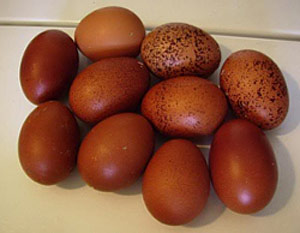
WelsummerEggsWelsummers will adapt well to any environment, although they thrive with the ability to forage, with a   very friendly demeanor. They lay approximately 200 large brown eggs a year, of a dark brown color, some even lay a speckled egg. They do not go broody, so they make a good choice for back yard egg layers. Overall, the Welsummer makes an excellent choice for a backyard chicken, or a small egg farming operation. 
If you enjoyed this article, want to know more about this or other related interesting topics, please like and share this article. Be sure to like us, so you don’t miss anything, we are Sweet Basil Farm & Gardens, on Facebook, Google+, Twitter and other social media. We are a local producer of farm fresh fruits and vegetables and members of the American Poultry Association, licensed by the Georgia Dept. of Agriculture as Poultry Dealers and Brokers, and a proud member of the Georgia Grown program, a division of the Georgia Dept. of Agriculture. We also breed, sell and ship poultry, pet pigs, bearded irises and much more. We have an 80 acre working farm, putting great emphasis on all natural gardening and livestock management practices. An 1840s general store is situated on our property, and serves as our on-site farmer’s market. Fresh garden vegetables, fruit nuts, eggs and flowers straight from the garden to you. We pick during the week, YOU pick available on Friday and Saturday. Conveniently located off of Interstate 75 near the Johnstonville Rd exit (#193).  We are six miles west, located in Barnesville, Lamar County, Georgia.
Special thanks to the American Standard of Perfection by the American Poultry Association, The Chicken Encyclopedia by Gail Damerow, Storey’s Illustrated Guide to Poultry Breeds by Carol Ekarius, Hobby Farms Guide to Chicken Breeds, Poultry World, the magazine for helpful information, as well as contributions from J. David Matthews, of Barnesville, Georgia in preparation of this article. Photo credits to imgkid.com, Pinterest, and Kellogg's. 

Monday, May 11, 2015

Easy Spicy Honey-Glazed Chicken Breasts Recipe from Sweet Basil


This sweet and spicy chicken recipe tastes like a gourmet recipe, but can be done in the same amount of time of preparing Hamburger Helper. You can use farm fresh products for most of the ingredient list. 


ingredients


  • 1/4 cup extra-virgin olive oil
  • 1 small onion, finely chopped
  • 1 clove garlic, finely chopped
  • 1/2 cup honey
  • 2 teaspoons hot pepper sauce
  • 1/2 teaspoon chili powder
  • 1 teaspoon lemon juice
  • 8 skinless, boneless chicken breasts (about 4 pounds)
  • Salt
  • 1 pineapple peeled, cored and cut into 8 thick rings


directions
  1. In a small saucepan, heat 1 tablespoon olive oil over medium heat. Add the onion and garlic and cook, stirring, until translucent and beginning to brown, 6 to 8 minutes. Add the honey, hot pepper sauce and chili powder and simmer for 1 minute. Remove from the heat, stir in the lemon juice and set aside.
  2. Preheat a grill or large grill pan to medium-high. Rub the chicken with the remaining 3 tablespoons olive oil and season with salt. Grill until well marked, about 7 minutes. Flip and cook until the bottoms are well marked and the chicken is cooked through, another 2 minutes. Transfer to a plate and brush with the reserved honey glaze. Cover with foil and let rest for 5 minutes.
  3. Meanwhile, grill the pineapple until well marked on one side, about 4 minutes, then flip and cook for another 2 minutes. Serve with the chicken.

Enjoy! 

We are Sweet Basil Farm & Gardens on Facebook. We are a local producer of farm fresh fruits and vegetables and members of the American Poultry Association, licensed by the Georgia Dept. of Agriculture as Poultry Dealers and Brokers, and a proud member of the Georgia Grown program, a division of the Georgia Dept. of Agriculture. We also breed, sell and ship poultry, pet pigs, bearded irises and much more. We have an 80 acre working farm, with great emphasis on all natural gardening and livestock management practices. An 1840s general store is situated on our property, and serves as our on-site farmer’s market. Conveniently located off of Interstate 75 near the Johnstonville Rd exit (#193).  We are six miles west, located in Barnesville, Lamar County, Georgia.
Special thanks to Rachel Ray for the fabulous recipe, as well as contributions from J. David Matthews, of Barnesville, Georgia in preparation of testing this recipe.

Fresh In Season Grilled Ratatouille Boats Recipe From Sweet Basil


I am excited to say that zucchini season is upon us...this is a favorite side dish for using fresh zucchini, tomatoes, parsley and garlic! This dish is not only quick and easy, but healthy, too!! You could also substitute eggplant for the boats, but make sure to increase the ingredients in the recipe by at least 1/4, depending on the size of your eggplant. This would compliment and complete a meal with  Spicy Honey-Glazed chicken.

Ingredients
  • 2 zucchini, halved lengthwise
  • 3 tablespoons EVOO
  • 1 onion, chopped
  • 2 cloves garlic, grated
  • 1 eggplant, cubed
  • 2 tomatoes, chopped
  • 1/4 cup chopped parsley
  • Salt and pepper
  • 1/3 cup shredded mozzarella cheese
directions 
  1. Scoop balls of flesh from the center of the zucchini to create boats (see tip for help); reserve the flesh balls. Preheat a grill to medium-high.
  2. Heat 1 tbsp. EVOO in a large skillet over medium heat; add the onion and cook for 5 minutes. Stir in the garlic and cook for 1 minute. Add the remaining 2 tbsp. EVOO, the eggplant and zucchini balls; cover and cook for 8 minutes. Add the tomatoes and cook, stirring, until the mixture is thick, about 5 minutes. Stir in the parsley; season with salt and pepper.
  3. Fill the zucchini shells with the ratatouille, sprinkle with the cheese and grill, covered, over medium-high until the cheese is melted and the shells are slightly softened.

Enjoy! 

We are Sweet Basil Farm & Gardens on Facebook. We are a local producer of farm fresh fruits and vegetables and members of the American Poultry Association, licensed by the Georgia Dept. of Agriculture as Poultry Dealers and Brokers, and a proud member of the Georgia Grown program, a division of the Georgia Dept. of Agriculture. We also breed, sell and ship poultry, pet pigs, bearded irises and much more. We have an 80 acre working farm, with great emphasis on all natural gardening and livestock management practices. An 1840s general store is situated on our property, and serves as our on-site farmer’s market. Conveniently located off of Interstate 75 near the Johnstonville Rd exit (#193).  We are six miles west, located in Barnesville, Lamar County, Georgia.
Special thanks to Rachel Ray for the fabulous recipe, as well as contributions from J. David Matthews, of Barnesville, Georgia in preparation of testing this recipe.

Thursday, May 7, 2015

Bourbon Chocolate Cake: A Sweet Treat Recipe from Sweet Basil

Bourbon Chocolate Cake Recipe
INGREDIENTS

  • 11 oz. semisweet chocolate, chopped
  • 6 oz. (12 Tbs.) unsalted butter
  • 6 large eggs, separated, at room temperature
  • 3/4 cup packed light brown sugar
  • 1 oz. (1/4 cup) all-purpose flour
  • 1/4 cup bourbon
  • 1 tsp. pure vanilla extract
  • 1/2 tsp. kosher salt
  • 1 cup heavy cream
  • 1 to 2 Tbs. granulated sugar
  • Confectioners’ sugar for dusting
DIRECTIONS 

Position an oven rack on the middle rung and heat the oven to 350°F.
Butter a 9x3-inch round cake pan. Line the bottom of the pan with a round of parchment and butter the parchment. Set the cake pan in a roasting pan large enough to accommodate it.
Melt the chocolate and butter over a double boiler. Remove from the heat and let cool slightly.
With an electric mixer (a stand mixer with the whip attachment or a hand mixer), beat the egg yolks with the brown sugar on medium speed until very pale, thick, and fluffy, about 3 minutes. Reduce the speed, add the chocolate mixture, and mix just to combine. Add the flour, mixing just to combine and scraping the bowl as needed. Blend in the bourbon and vanilla. Transfer to a large mixing bowl and set aside.
In a clean mixing bowl with clean beaters, beat the egg whites with the salt on high speed until they hold soft peaks, 1 to 2 minutes. With a rubber spatula, fold one-third of the egg whites into the chocolate mixture to lighten it, and then gently fold in the remaining whites. Scrape the batter into the prepared cake pan.
Set the roasting pan on the oven rack and add enough warm tap water to come halfway up the sides of the cake pan. Bake until the top feels set, 40 to 45 minutes. Remove the cake pan from the water bath and run a paring knife around the inside of the pan (or the inside of the parchment collar) to loosen the cake and then let the cake cool completely in the cake pan on a rack. When the cake is completely cool, loosen the sides once more with a paring knife. Cover the cake with a serving plate and invert the cake onto the plate. The bottom of the cake is now the top. Peel off the parchment. (Don’t worry if the surface looks a little ragged; you’ll be dusting with confectioners’ sugar).
To serve: In a chilled bowl with chilled beaters, beat the cream and sugar to medium-soft peaks. Dust the top of the cake generously with confectioners’ sugar, slice, and serve each slice with the whipped cream.
Enjoy! 
If you enjoyed this recipe, want to know more about this or other related interesting topics, please like and share this recipe. Be sure to like us, so you don’t miss anything, we are Sweet Basil Farm & Gardens, on Facebook and other social media. We are a local producer of farm fresh fruits and vegetables and members of the American Poultry Association, licensed by the Georgia Dept. of Agriculture as Poultry Dealers and Brokers, and a proud member of the Georgia Grown program, a division of the Georgia Dept. of Agriculture. We also breed, sell and ship poultry, pet pigs, bearded irises and much more. We have an 80 acre working farm, putting great emphasis on all natural gardening and livestock management practices. An 1840s general store is situated on our property, and serves as our on-site farmer’s market.Fresh garden vegetables, fruit nuts, eggs and flowers straight from the garden to you. We pick during the week, YOU pick available on Friday and Saturday. Conveniently located off of Interstate 75 near the Johnstonville Rd. exit, in Lamar County. 
Special thanks to the finecooking.com for a great recipe, as well as contributions from J. David Matthews, of Barnesville, Georgia in preparation of this article. Photo credits to  SCOTT PHILLIPS. 

Wednesday, May 6, 2015

Spring Perennial Care Tips from Sweet Basil

In-season mulching

Most perennials benefit from applications of organic mulches during the growing season to retain moisture in the soil and smother weeds during the growing season. Grass clippings, shredded leaves or bark, compost, and other organic materials also improve the soil as they break down.

Watering

While some perennials are drought-tolerant, many need plenty of water. If the soil dries out due to lack of rain, it's important to thoroughly soak the soil when you water, not just wet the surface. It's also important to keep the foliage and flowers as dry as possible to prevent disease. Soaker hoses and drip irrigation do this best. If you use sprinklers, run them in the morning so that the plants dry quickly in the sun. Watering individual plants by hand takes patience to supply enough water to thoroughly soak the soil.

Fertilizing

Most perennials do not require heavy fertilization. You can work in a small handful of low-nitrogen fertilizer (5-10-5, for example) in a ring around the plant in early spring, and perhaps again two more times at 6-week intervals. Fertilize late-flowering plants once more in late summer. Total application should be less than 4 to 5 pounds per 100 square feet. Keep fertilizer off foliage to prevent burning. Use slow-release or organic fertilizers to reduce burning concerns. Organic fertilizer is available at most big box stores, or make your own with compost and other organic matter.

Staking

Some taller perennials tend to fall over, especially when they are heavy with flowers. To keep them upright, you can locate them so other plants help support them, or back them up against a fence or other structure and fasten them with twine. Another alternative is to insert stakes of wood, bamboo, or other unobtrusive material in the soil adjacent to plants while they are still small and, as they grow, fasten the plants to the stake. Be careful to avoid damaging roots. Other commercial products are available to support plants.

Pinching

Some branching perennials respond well to pinching -- removing the growing tips by pinching off the small, developing leaves at the ends of stems. This forces more lateral growth, making the plant bushier and shorter. Aggressive pinching may delay flowering in some species or cause plants to flower at a shorter height. Perennials such as Asters, boltonia, Russian sage, garden phlox, and upright sedums (such as 'Autumn Joy'), as well as annuals of Zinnias, Geraniums, begonias and more  respond well to pinching.

Thinning

This practice helps increase air circulation and prevent disease in perennials, such as garden phlox and beebalm, that are prone to mildew and fungal leaf spots. When these plants are about a quarter of their full height, cut half of the stems to ground level. This can also increase stem strength and flower size. Pruning before flowering You may want to cut back some perennials by 12 to 18 inches in early summer. Prune them before flower buds are set (Azaleas) or, for late-summer or early-fall blooms, after the buds are set but before flowers open. (Caution: With some species, pruning after flower bud set will eliminate flowering altogether.) This will delay flowering and shorten flowering height, so plants are less likely to flop without staking. For example, if you cut back coneflowers in early June, they will bloom until late September. If cut back in early July, they will bloom into October. Pruning after flowering some early bloomers, such as creeping phlox, perennial candytuft, and rockcress, may bloom again if sheared back by half immediately after their first bloom. Many summer bloomers benefit by cutting back to the leaves at the bottom of the plant after flowering. Try this with yarrow, ladies' mantle, shasta daisy, delphinium, cranesbill (geranium), catmint, salvia, and veronica. Depending on species, age, and other factors, other summer bloomers do better with less aggressive pruning.


Disbudding

With some perennials, especially those used for cut flowers such as peonies, Dahlias and chrysanthemums, you can encourage fewer but larger blooms by removing the smaller lateral flower buds, forcing plants to put more energy into the terminal bud remaining at the top of the plant. Or you can remove the terminal bud and encourage more (but smaller) lateral flowers.

Deadheading

Remove spent flowers after blooms start to fade. This keeps the plants from wasting energy on seed production and keeps them looking neat. In some species, deadheading can encourage another flush of flowering. It also prevents perennials that reseed aggressively from spreading where you don't want them. Some of these include Gerbera Daisies, Salvia, flowering onions, columbines, golden marguerite, foxglove, coneflower, feverfew, Siberian iris, and balloon flower. To attract birds to your garden, don't deadhead species with seed favored by birds, such as coneflowers, black-eyed Susans and sunflowers. Deadheading biennials sometimes encourages them to overwinter an additional season. As a general rule, only remove the faded blossom and stem down as far the next healthy blossom or set of leaves. With some perennials, it's best to cut back to the leaves at the bottom of the plant after they are finished flowering.

Deadleafing

Remove dead leaves to make room for new foliage. This improves the appearance and health of the plant. Dead leaves may be natural or they may be a symptom of larger problems. Fall care Cut back most perennials to about 3 inches from the ground. Any closer may damage crowns. Remove debris from the garden to help prevent diseases. Wait until spring to cut back some species, including European ginger, bishop's hat, ferns, Lenten rose, ornamental grasses, and upright sedums (such as 'Autumn Joy'). In addition to adding winter interest, some perennials overwinter better if left uncut. If the growing season has been dry, water deeply in fall before the ground freezes.

Division

Many perennials begin to decline after a few years. They don't grow as vigorously as they did the first few years after planting and they flower less. The center of the clump may appear dead, with little or no growth. When this happens, it's a good sign that the plant is ready to be divided. The best times and methods of dividing perennials varies with species. In most cases, you divide plants when they are dormant, either early in the season before they break dormancy or in fall so that the roots of the new plants can get settled in before the ground freezes. In most instances, you dig out the entire plant, wash the soil off the roots, and cut or pull them apart into several or many pieces. Sometimes this can be quite difficult, especially with older plants and ornamental grasses, requiring the use of shovels, spading forks, or picks. Focus on preserving the newer, more vigorous roots and discard older or diseased parts. Replant the divisions into a larger area than the plant once occupied, using the same spacings and soil preparation that you would use for new plantings. 


If you enjoyed this article, want to know more about this or other related interesting topics, please like and share this article. Be sure to like us, so you don’t miss anything, we are Sweet Basil Farm & Gardens, on Facebook and other social media. We are a local producer of farm fresh fruits and vegetables and members of the American Poultry Association, licensed by the Georgia Dept. of Agriculture as Poultry Dealers and Brokers, and a proud member of the Georgia Grown program, a division of the Georgia Dept. of Agriculture. We also breed, sell and ship poultry, pet pigs, bearded irises and much more. We have an 80 acre working farm, putting great emphasis on all natural gardening and livestock management practices. An 1840s general store is situated on our property, and serves as our on-site farmer’s market.Fresh garden vegetables, fruit nuts, eggs and flowers straight from the garden to you. We pick during the week, YOU pick available on Friday and Saturday. Conveniently located off of Interstate 75 near the Johnstonville Rd exit (#193).  We are six miles west, located in Barnesville, Lamar County, Georgia.
Special thanks to the gardening department at Cornell University for a great publication, as well as contributions from J. David Matthews, of Barnesville, Georgia in preparation of this article. Photo credits to landscapenashville.com. 

Tuesday, May 5, 2015

Meet the Brahma Breed of Chicken

dark-brahma-henHISTORY
While the exact origination is unknown of the Brahma, the history is rich. Brahmas are an Asiatic breed of fowl, and is believed to be a cross created in India of the Malay and Cochin, and imported from Shanghai, China. The Brahma was originally called Gray Shanghais (also Shanghaes) and Brahma Pootras (for the river Brahmaputra in India), and was a color in between the Light and Dark. The Light variety was perfected in America, while the Dark variety was perfected in England. The American Poultry Association admitted the the Light and Dark Brahma into the first American Standard of Excellence, in 1874, although the Brahma had landed in America long before. The Buff variety was admitted in 1924. 
QUALITIES and ATTRIBUTES 
Although the American Poultry Association only recognizes three varieties, there are several other colors that would be well suited for backyard chickens, such as Partridge, Gold Partridge, Blue Partridge and Black. The weight of a hen should be 9 1/2 pounds, and the rooster 12 pounds. The beautifully feathered legs and feet, as well as the small pea combs, make them not only stand apart from other breeds, but also thrive in colder weather. (Although they are also very heat tolerant.) 
Don't let the large size of Brahmas scare you, they are very gentle and quite docile. While they tolerate confinement, they do best allowed to free range. (Their size protects them from aerial predators.) Brahmas are a heavy bird, making them a good choice for a meat bird, but also lay fairly well, especially in the winter months. They do go broody easily, so they make a good choice to hatch their own chicks. Overall, the Brahma makes an excellent backyard chicken! 
If you enjoyed this article, want to know more about this or other related interesting topics, please like and share this article. Be sure to like us, so you don’t miss anything, we are Sweet Basil Farm & Gardens, on Facebook and other social media. We are a local producer of farm fresh fruits and vegetables and members of the American Poultry Association, licensed by the Georgia Dept. of Agriculture as Poultry Dealers and Brokers, and a proud member of the Georgia Grown program, a division of the Georgia Dept. of Agriculture. We also breed, sell and ship poultry, pet pigs, bearded irises and much more. We have an 80 acre working farm, putting great emphasis on all natural gardening and livestock management practices. An 1840s general store is situated on our property, and serves as our on-site farmer’s market.Fresh garden vegetables, fruit nuts, eggs and flowers straight from the garden to you. We pick during the week, YOU pick available on Friday and Saturday. Conveniently located off of Interstate 75 near the Johnstonville Rd exit (#193).  We are six miles west, located in Barnesville, Lamar County, Georgia.
Special thanks to the American Standard of Perfection by the American Poultry Association, The Chicken Encyclopedia by Gail Damerow, Storey’s Illustrated Guide to Poultry Breeds by Carol Ekarius, Hobby Farms Guide to Chicken Breeds, Poultry World, the magazine for helpful information, as well as contributions from J. David Matthews, of Barnesville, Georgia in preparation of this article. Photo credits to Fowlvision.

Sunday, May 3, 2015

Our Daily Bread at Sweet Basil Farm Gardens (5.3.15)

Gardening...is the closest one can come to being present at creation.
We are Sweet Basil Farm & Gardens on Facebook. We are a local producer of farm fresh fruits and vegetables and members of the American Poultry Association, licensed by the Georgia Dept. of Agriculture as Poultry Dealers and Brokers, and a proud member of the Georgia Grown program, a division of the Georgia Dept. of Agriculture. We also breed, sell and ship poultry, pet pigs, bearded irises and much more. We have an 80 acre working farm, with great emphasis on all natural gardening and livestock management practices. An 1840s general store is situated on our property, and serves as our on-site farmer's market. Conveniently located off of Interstate 75 near the Johnstonville Rd exit (#193).  We are six miles west, located in Barnesville, Lamar County, Georgia.
Special thanks to Brainy Quotes for the inspirational quote, as well as contributions from J. David Matthews, of Barnesville, Georgia in preparation of this article. Photo credits to fennel and fern.co.uk, photographed Iris garden designed by Jinny Blom.

MEET THE RHODE ISLAND RED CHICKEN

Rhode_Island_Red_cock,_croppedHISTORY
The Rhode Island Red chicken was deliberately created for high egg production, high-quality meat production and resistance to some diseases, with development beginning around the mid-1800’s. It was named the Rhode Island Red, after the state of it’s origination. The American Poultry Association admitted the single comb variety in 1904, and the rose comb variety in 1905. During the 1940’s, when commercial egg production exploded, the production variety was created. In 1954, the Rhode Island Red became the State bird of Rhode Island, making it the only breed the American Poultry Association recognizes to have such an honor.
QUALITIES and ATTRIBUTES 
Many experts consider the Rhode Island Red to be the most popular variety of chicken in the United States, and possibly the world. The feathers on the body, hackle (collective group of feathers along neck) and saddle (cock’s long pointed feathers on the rear of the back)  are a lustrous dark, rich red color, with the undercolor (fluff underneath the feathers) a rich intense red. The wings are black, outlined with red and tail feathers are a lustrous greenish black, giving this bird its striking appearance.
The single comb variety should be moderately large and have five, well defined points. The Rose comb should be moderately large and close on head, oval shaped and the surface covered with small, rounded points. Both varieties have red combs and medium sized wattles (two flaps that dangle under the beak). Mature cocks should weigh about 8 1/2 pounds, and hens about 6 1/2, making them a nice table bird. Hens lay more than 200 large brown eggs, annually, and hens (heritage breeds) that brood make nice mothers. Due to their calm, docile personalities, they do well in confinement as well as a backyard chicken. Fencing for containment need not be high, the Rhode Island Red does not display strong flying skills. However, they also do well in a free range environment. Rhode Island Reds tolerate heat well, making them an excellent breed for warmer areas.
To learn more about this breed, or other breeds, like or comment below. If you enjoyed this article, want to know more about this or other related interesting topics, please like and share this article. Be sure to like us, so you don’t miss anything, we are Sweet Basil Farm & Gardens on Facebook. We breed sell and ship poultry, pet pigs, bearded irises and much more. We have an 80 acre working farm, with great emphasis on all natural gardening and livestock management practices. We are blessed to have an 1840s General Store on our property which serves as our own site farmer’s market. Conveniently located on Johnstonville Rd., in Barnesville, Georgia, right off of I-75.
Special thanks to the American Standard of Perfection by the American Poultry Association, The Chicken Encyclopedia by Gail Damerow, Storey's Illustrated Guide to Poultry Breeds by Carol Ekarius,  for helpful information and contributions from David Matthews, of Barnesville, Georgia in preparation of this article. Photo credits to Wikipedia.